
Home » Types of Magnets » Ceramic Magnets
Ceramic Magnets
| Features | Applications | Magnetizing |
| Machining | Manufacturing Process | Properties |
Ceramic magnets are permanent magnets made up of a composite of iron oxide and barium/strontium carbonate. Through pressing and sintering ceramic magnets are made. These magnets are also made in different grades. They are widely used magnets with good magnetic strength and resistance to demagnetization. The color of ceramic magnet is charcoal gray and they normally appear in the forms of discs, rings, blocks etc.
Features
- Since the ceramic refrigerator magnets are hard and brittle in nature therefore for their finishing they require diamond cutting or cutting wheel.
- They can acquire only simple shapes.
- These magnets have excellent intrinsic coercive force.
- As compare to other rare earth and alnico magnets they are less expensive.
- They are available in different grades like 1, 5, 8 of which grade 8 is the strongest.
- Ceramic magnets have low service temperature as compared to rare earth magnets.
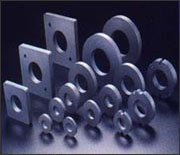 Ceramic magnets find their applications in the following fields:
- DC permanent magnet motors
- DC brushless motors
- Speaker magnets
- Magnetic resonance imaging
- Separators that is it separates ferrous material from non-ferrous materials
- In magnetic assemblies meant for lifting, holding, retrieving, and separating
- Food processing industries
For magnetization of ceramic ferrite magnets, moderate magnetizing field is necessary. Normally it is desirable to magnetize the magnet with a mild steel element such as a motor housing or backing-plate. The anisotropic ceramic magnets results in a single direction of magnetization.
Machining
The ceramic ferrite magnets are brittle hence it is necessary that special care and attention must be taken while machining. Normally diamond tools and some abrasive are used for the fabrication of this magnet. Once the magnet is fabricated, it is magnetized.
Ceramic Magnets Manufacturing Process
The first step involved in the manufacturing of the ceramic magnet involves the calcining of a mixture of iron oxide and strontium carbonate to form a metallic oxide. The milling of the materials reduce the calcined materials in the fine powders which is later compacted in a die by different methods. In one of the methods powder is compacted dry, developing an isotropic magnet with weaker magnetic properties. In other method powder mixed with water to form slurry which is later pressed in the presence of magnetic which creates an anistropic magnet with better magnetic qualities.
The compacted magnets are then sintered at high temperatures to achieve the final fusion of the individual particles
Magnetic and Thermal Properties
| Material Grade | Composition | Magnetic Properties | |||||||
| [M = Ba, Sr or a mixture of the two elements]. | Max Energy Product BHmax (MGOe) (kJ/m3) | Residual Induction Br | Coercivity Hc (kOe) (kA/m) | Intrinsic Coercivity Hcl (kOe) (kA/m) | |||||
| Ceramic 1 | MO · 6Fe2O3 | 1.05 | 8.35 | 2.30 | 230 | 1.86 | 150 | 3.25 | 260 |
| Ceramic 5 | MO · 6Fe2O3 | 3.40 | 27.1 | 3.80 | 380 | 2.40 | 190 | 2.50 | 200 |
| Ceramic 7 | MO · 6Fe2O3 | 2.75 | 21.9 | 3.40 | 340 | 3.25 | 260 | 4.00 | 320 |
| Ceramic 8 | MO · 6Fe2O3 | 3.50 | 27.8 | 3.85 | 385 | 2.95 | 235 | 3.05 | 245 |